
Grid instability across the Middle East is not seasonal. Utilities in Kuwait, the UAE, Saudi Arabia, Jordan and Iraq all face peak-summer load shedding, while industrial sites - from oil and gas plants to telecom towers and water pumping stations - sit in one of the most hostile climates on earth for electronics. A UPS specified for a European office will not last a single summer.
This guide explains how to specify a desert-duty industrial UPS.
The Four Threats
· Extreme heat: 45-50C ambient, often above 55C inside a non-ventilated cabinet. VRLA batteries lose about half their life above 40C.
· Dust and sand: fine particles pass through filters and coat PCBs, causing thermal and creepage faults. Sandstorms add silica and salt to the mix.
· Wide temperature swings: 40C days and 15C nights stress connections and charging algorithms.
· Weak grid with generator backup: long deep brownouts and frequent generator transfers demand a generator-compatible rectifier.
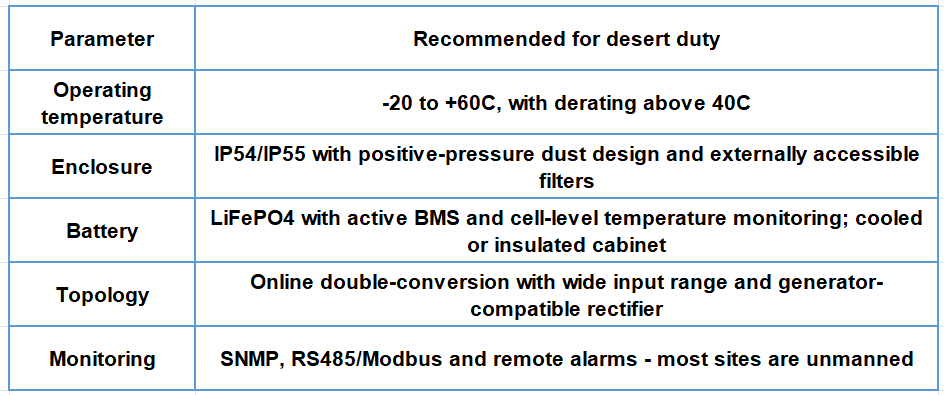
Specification Checklist
· Telecom base stations: 3-10 kVA outdoor UPS with solar or DC hybrid, low maintenance and remote monitoring.
· Oil, gas and water plants: 20-200 kVA industrial UPS in a separate battery room with electrostatic filters.
· Hospitals and clinics: dual-bus online UPS with medical-grade isolation.
· Smart city and traffic infrastructure: compact IP-rated UPS with sealed battery.
Maintenance that Actually Extends Life
1. Clean or replace dust filters monthly in summer; blocked filters alone can double internal cabinet temperature.
2. Check battery terminal torque and cleanliness twice a year - heat and dust loosen and corrode connections.
3. Test load transfer and generator start-up every quarter.
4. Monitor cabinet temperature remotely, not just battery voltage.
FAQ
Is IP55 really necessary? For outdoor and semi-outdoor sites, yes. Indoors with filtered airflow, an IP31 cabinet is acceptable if you add positive pressure.
Can lithium batteries handle desert heat? Yes. LiFePO4 with a BMS is the preferred option as long as the battery cabinet is shaded or cooled.
What certifications do Middle East projects require? Typically IEC 62040-1/-2/-3, plus local approvals such as ESMA in the UAE and DEWA rules for Dubai grid connections. Confirm project-specific requirements with your supplier.
Get a Desert-Duty Solution
General Power Tech designs, supplies and supports APC and EATON UPS systems with lithium batteries, industrial cabinets and remote monitoring.
miwa@generalpowertech.com or +852 69482197.