
Why Factory Power in Southeast Asia Is a Different Problem
A UPS that works in a European office rarely survives a Southeast Asian production floor. Vietnamese, Indonesian, Thai and Philippine plants run on grids where voltage sags of 15-20%, short outages and lightning-induced transients are weekly events - and where 30-35 C ambient temperatures with high humidity age batteries far faster than the datasheet suggests.
For plant engineers the question is specific: which UPS keeps a 380-400 V three-phase line of CNC machines, PLCs and injection moulders running through a sag, a blackout and a generator start-up?
Five Specifications That Matter on the Factory Floor
1. Three-phase input, three-phase output. Most Southeast Asian industrial supply is 380-400 V, 50 Hz. A single-phase UPS cannot protect a three-phase motor load; specify a true three-phase online double-conversion unit and confirm the neutral arrangement on site.
2.A wide input window, not just a stable one. Look for models that accept roughly -25% / +15% input voltage and switch to battery without disruption, so the UPS rides through sags instead of transferring to bypass.
3.Tropical protection. Conductive dust, humidity and condensation kill electronics. Specify conformal-coated boards, IP-rated enclosures where washdown occurs, and filtered front-to-back airflow.
4.Generator compatibility. In Vietnam and Indonesia, factory backup is often a diesel genset. The UPS must tolerate an unstable generator waveform and offer an adjustable transfer window, otherwise it will go to battery every time the genset picks up load.
5.Maintainability. Remote monitoring via SNMP or cloud turns battery replacement from an emergency into a planned shutdown. This matters where one engineer covers several plants.
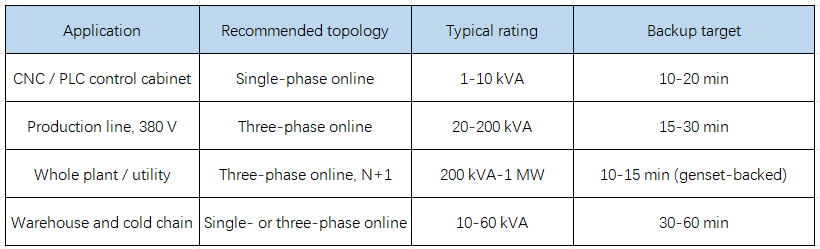
Quick Selection Matrix
Where Lithium Wins in Tropical Plants
Lithium iron phosphate (LiFePO4) cabinets cost more upfront, but in Southeast Asia they often pay back within the first battery-replacement cycle. They tolerate higher operating temperatures with less capacity loss, need no dedicated battery room, and their battery management system reports state of health before a sag exposes a weak string.
Frequently Asked Questions
Can I use a 230 V single-phase UPS for a 380 V machine?
No. Match the phase configuration of the load; a voltage-only match will trip the input protection.
How much runtime do I need?
Size for the realistic gap between the mains failure and the generator carrying load - usually 10-20 minutes - plus a margin for battery ageing.
Yes. Units from 1 kVA to modular 1 MW systems, three-phase 380-400 V options, and LEOCH battery supply and replacement.
Conclusion