
Storms Test More Than the Grid
Every September, facilities from Puerto Rico to Florida and the Gulf Coast face the same sequence: a sustained outage, a generator that carries only part of the load, and weeks of unstable power during recovery. A UPS sized for a normal Tuesday will not hold up under those conditions - and the failures usually appear in the first hour, not the last.
Why Storm Outages Break Ordinary UPS Systems
Storm damage does not produce clean blackouts. It produces repeated interruptions, low voltage as feeders are re-energised, and long generator runs with dirty waveforms. Three failure modes dominate: batteries that lost capacity during the summer heat, UPS units that cannot accept a generator’s output and drop to bypass, and runtime that was never sized for a multi-hour event.
Five-Point Pre-Season Checklist
1.Test the batteries, do not assume them. A capacity test under load shows real runtime. In 30-35 C conditions, VRLA batteries can lose a third of their service life in two or three years.
2. Verify generator compatibility. Wide input windows, adjustable transfer thresholds and slow frequency tracking stop the UPS from rejecting the genset waveform.
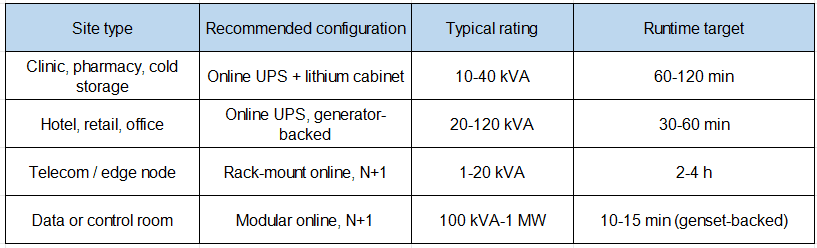
3. Size runtime for the gap, then add margin. Aim for the time between the outage and generator stability, plus 20-30 minutes of recovery margin.
4. Protect against water and salt air. Coastal and flood-prone sites need elevated cabinets, IP-rated enclosures and conformal-coated boards.
5. Add remote monitoring. During a storm nobody can drive to site; SNMP or cloud alerts tell you which cabinet needs attention first.
Lithium Versus Lead-Acid in Storm-Prone Regions
Lithium iron phosphate cabinets weigh roughly half as much, tolerate heat better, and report state of health continuously, so a weak cell is identified before the storm arrives rather than during it. For rooftop, flood-prone and unairconditioned sites, that combination usually justifies the higher purchase price within one replacement cycle.
Frequently Asked Questions
How long will a UPS run without a generator?
It depends entirely on the battery cabinet - a 20 kVA online UPS with a one-hour lithium cabinet can hold a small clinic through the worst of a storm, while the same UPS with ten minutes of internal battery cannot.
Should the UPS run the air conditioning?
No. Keep the UPS on critical loads - IT, controls, medical and refrigeration equipment - and let the generator carry HVAC.
Do you ship to the Caribbean and Latin America?
Conclusion