
Across the Gulf, backup power is no longer a “nice to have”. AI data centers in Dubai and Riyadh, 5G rollouts, hospital expansions and oil-and-gas automation all run on loads that cannot tolerate a single mains dip. That is why buyers in the UAE and Saudi Arabia now shortlist an uninterruptible power supply (UPS) by architecture, not by price alone.
Why UPS Selection in the Gulf Is Different
Four local factors decide whether a UPS survives its warranty period:
●Heat: ambient temperatures above 45 °C shorten valve-regulated lead-acid (VRLA) battery life dramatically.
●Dust and humidity: coastal sites near Jebel Ali or Dammam combine salt air with fine sand.
●Generator switchover: a UPS must bridge the 10–30 second gap before the genset takes load.
●Grid quality: voltage sag, frequency drift and phase imbalance are common on 400 V / 50 Hz supplies.
Match the UPS Architecture to the Load
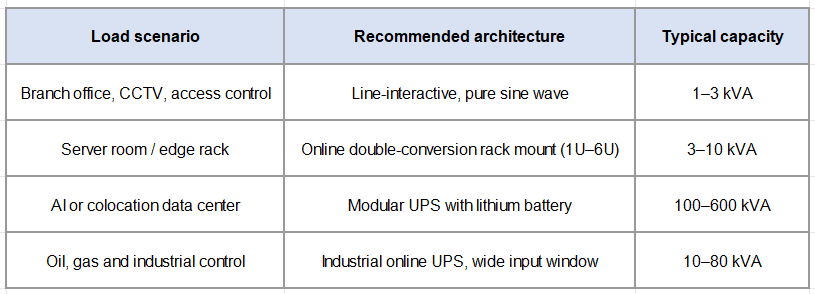
1.List every protected load in watts: servers, switches, storage, cooling controls.
2.Convert to VA: watts ÷ 0.9 power factor. A 900 W load needs roughly 1,000 VA.
3.Add 25–30 % headroom for inrush current and future growth.
4.Convert the runtime you need into battery capacity — and choose chemistry by temperature, not by habit.
Features Gulf Buyers Ask For Most
●Wide input voltage and frequency windows (e.g. 110–300 V AC) for unstable grid conditions.
●Lithium iron phosphate (LiFePO4) batteries rated to 50 °C, with a BMS and remote monitoring.
●SNMP, Modbus and dry-contact interfaces for BMS and DCIM integration.
●Dust filtration, conformal-coated boards and IP-rated enclosures for coastal sites.
●Three-phase 400 V / 50 Hz input for large frames, plus 100/110/120 V models for marine and port equipment.
●Local spare parts, preventive maintenance and battery replacement — not just a box.
FAQ
Is a line-interactive UPS enough for a UAE office? Yes for workstations and network gear. Move to online double-conversion if you protect servers, medical devices or anything with a generator upstream.
How often should batteries be replaced in the Gulf? Plan on 3–4 years for VRLA and 8–10 years for lithium, with annual capacity testing.
Can I retrofit lithium batteries into an existing UPS? Often yes, if the charger and BMS are compatible — an engineering review is required first.
Need a sized recommendation for your site? Send your load list and runtime target to miwa@generalpowertech.com or call +852 69482197. General Power Tech supplies, installs and maintains EATON, APC and lithium UPS systems, batteries, PDU and precision distribution for data centers, ports and industrial sites.