
Most UPS platforms are built for 230 V grids. In Mexico, Brazil, the Caribbean, Japan and Taiwan, equipment runs on 100–127 V — and the wrong-voltage unit means derated capacity, nuisance transfers or outright failure.
This guide explains how to specify a 100V/120V UPS for commercial and industrial sites across the Americas.
Why 100V/120V Sites Need a Dedicated Platform
- Nominal voltage differs by market: 100 V in Japan and Taiwan, 110–120 V in North America and the Caribbean, 127 V in Mexico and parts of Brazil.
- Plugs and receptacle types differ (NEMA and local standards), so a 230 V unit cannot simply be adapted.
- Utility conditions include frequent voltage sags and storm-season outages, especially during hurricane season.
- Shipping, marine and port equipment often follows a 110/120 V standard and needs the same protection.
What Buyers in the Americas Prioritise in 2026
- Compliance first: UL 1778 / cUL listings, NOM certification for Mexico, ANATEL and INMETRO marks for Brazil.
- LiFePO4 lithium battery UPS: smaller footprint, longer service life and lower total cost of ownership.
- Storm resilience: 30–60 minutes of runtime plus a clean generator transfer interface.
- Integration: SNMP, Modbus and rack PDU monitoring so the UPS reports into existing DCIM and BMS tools.
- Serviceability: spare battery modules and technical support available in-region.
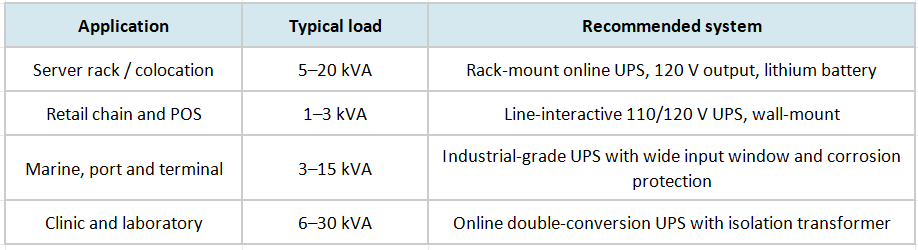
Recommended Configuration by Application
Specification Checklist
1. Confirm site voltage (100 V, 110 V, 120 V or 127 V) and frequency before ordering.
2. Check the certification marks your authority or client requires.
3. Size the load with 25% headroom and define runtime at full load.
4. Specify the monitoring protocol and alarm contacts needed.
5. Confirm battery replacement logistics for the site's country.
FAQ
A: Not safely or economically. Output, receptacles and certification all differ; specify a 100V/120V model instead.
Q: How long should backup last during hurricane season?
A: 30 minutes is the practical minimum; 60 minutes gives time for generator start or safe shutdown of critical systems.
Q: Is lithium worth the higher upfront price?
A: For most commercial sites, yes. Longer cycle life, less cooling demand and fewer battery replacements usually offset the difference within a few years.
Talk to a Power Engineer